Showing posts with label fair trade. Show all posts

Sunday, 27 November 2011

Community Health in my brave new world

Volunteers recieving award from Coop
Yesterday I took a couple of trees worth of willow along to the Heart of England NHS annual community health fair.  John Boyle from Midlands Coop had asked me to come - see Fairtrade Blog for more photos. 

I got lucky - on arriving a handful of volunteers from Joseph Chamberlain College helped me get set up, trial my activity, and spent the rest of the day wearing willow crowns and waving wands all around the event.  Someone from 'Heart of England NHS foundation asked if I could make a willow heart (why didn't I think of that?).  I gave it a go and before long, decorated heart wands were as popular as the stars.

Exchanging a 'wish for a wand' generated a tree worth of comments which reflected conversations we had making and decorating our wands.  The free chocolate, interestingly was turned down by many (on health and diet grounds?).  The event was really fun - great atmosphere, and got to meet loads of interesting and different folk.

It's glass half full, I know, but being cut off from my main source of revenue, training, networking, everything (creative partnerships) isn't all bad.  I probably wouldn't have got to go to this event, go to wikipedia workshop later next month, think more about what it is I want to do, sort out the garden, and generally work just as hard for half the money!  But today, I'm loving it.

Thursday, 24 February 2011

Kit on for Fairtrade started!

I planned to play home, safe, a week before fairtrade fortnight.  It was in half term and neither of our regular staff could be there, and the majority of parents we usually rely upon to support staff were on holiday, we had a high turnout (35 children) ranging in age from 0 to 8, and I had all three of my own children to watch out for too.

So I turned up 9:45 for 10, at the same time as the first of parents were arriving.  I decided to get out the bulkiest, heaviest kit out (why make things easy?), realised forgot bread - dash to shops, back again, Three children still there, and happy (don't worry, had good friends there to look out for them while I popped out to shops).

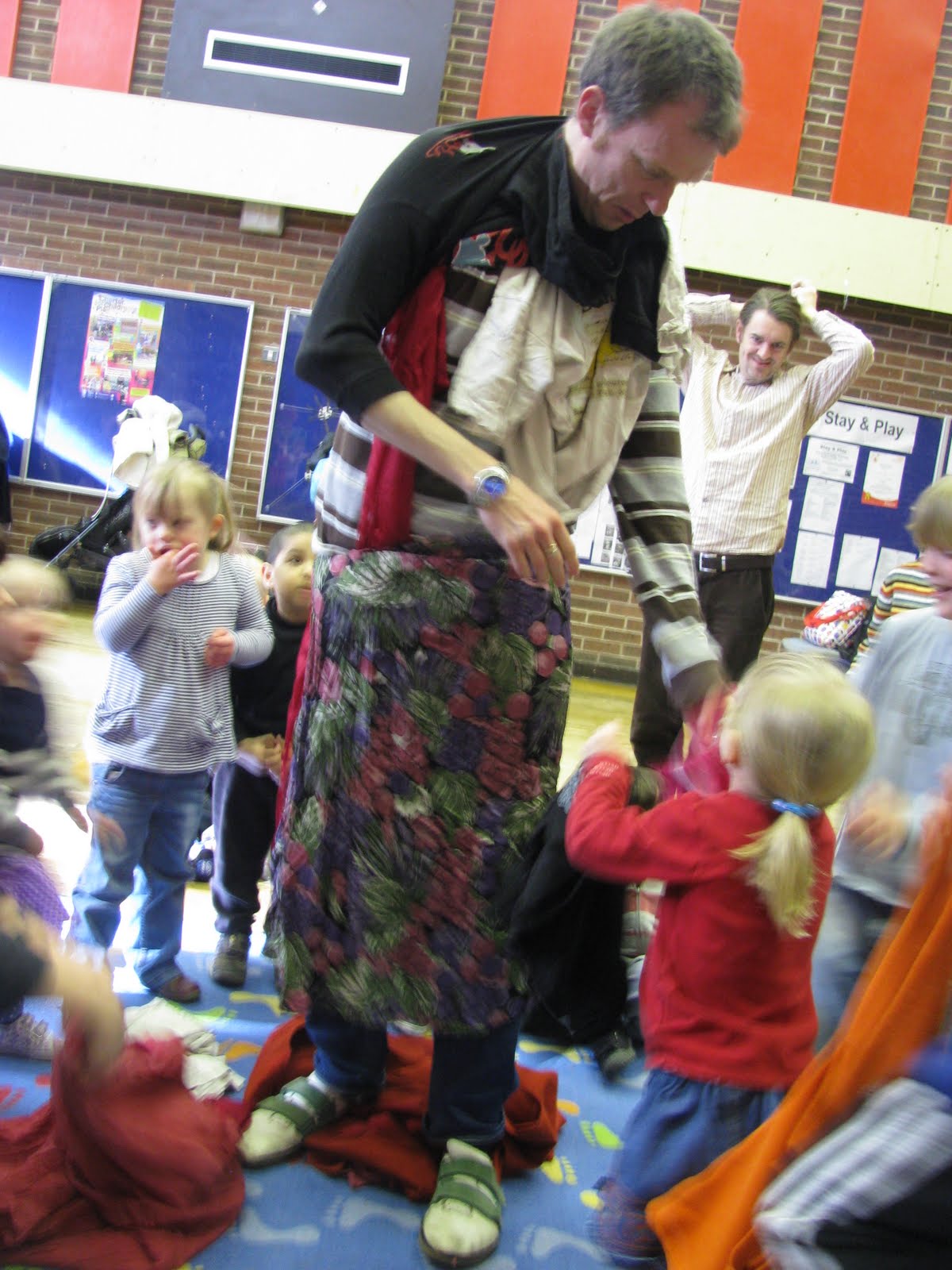
By the end of snacktime, I was hot, sweaty, tired and time to start 'Kit on' workshop.  Running a workshop with your own three children (2, 4 and 7) is a bit of a risk, but sometimes it can work to your advantage.  Today they really got into the activity and helped run it with their friends, and the parents of their friends.  I was particularly chuffed with the way Arthur and Jago talked about the day afterwards.

Patch in a dress
Paraphrasing Arthur describing to Mum - 'It was really good.  First we dressed up Patch (another Dad), then we worked in teams and dressed up our parents, but not Daddy.  Then we dressed some of the children.  I was one of them.  Then we dressed up everyone and we all got chocolate (thanks John Boyle and the Coop)  It was all for fairtrade because we should be buying fairtrade clothes.'

He'd got all of it, and understood the order (and probably why) of activities - choose someone willing to give anything a go (Patch), involve the parents, have fun (don't get pompous about fairtrade), get everyone participating.  I had been tempted to chat a bit about Uzbekistan and state sponsored child labour picking cotton and I'd totally forgotten to do the Cotton-picking song, and other songs (which was a shame).  Also not so sure how much the under twos got from it, but if they had fun putting clothes on Mum, then all is well.

Cotton picking interview
More Photos
Enhanced by Zemanta

Friday, 10 December 2010

The Highest European Standards

Another great day in LA, started off with search for a 'decent' cup of tea for Nikki.

We wondered over to 'coffee bean and tea leaf' - a californian coffeeshop chain. No trace of fairtrade - I've not seen the FT logo over here yet, and not yet confident enough to question shopkeepers on ethics, as I probably would in UK.

I have a lovely mocha latte on which the paper mug gives brief history of the company, and its claim to have always met 'the highest European standards' for its tea and coffee.

Now its true we English moan a lot about 'American' influence on our culture generally, and here was a proud claim to meet superior European standards. It's easy to feel at home in the US, with everyone so friendly (lost track of number of times strangers have made nice comments about our children) and so much shared culture - walking down hollywood boulevard all the names on the ground are as familiar in UK as in the US. Also like the UK, the stars are predominately white men.

While drinking my mocha, served by non-white shopkeepers, remembering the yellow school buses at Griffith Observatory, on public transport generally, and our visit to Santa Monica pier, with a distinctly Blackpool feel (albeit sunnier), outside the richest and most touristy spots of LA, it seems the population is mostly Mexican descent - something that had not occurred to me before visiting.

Just as in Europe, are the stars on the pavement in Hollywood, the stories of Hollywood dreams written in mosaic on the floor of the shopping mall, can these dreams be shared by the non-white cleaners?

Talking of which, hope I get to thank hotel cleaners who gave the kids some fun by placing our children's expanding collection of small soft toys in unusual locations around the beds.

Friday, 19 November 2010

Bringing technology to a new generation

It's not often I feel like a youngster in a meeting - that's the way it is if you work mainly in education.  Recently though, I've had two different meetings.  In both I bet people were thinking 'he's gone all techie again'.  So what better to do than come home and blog about it?

First meeting was in an old people's home I worked in a long while back, mainly doing art and craft workshops, possibly most known there for unusual crafty christmas thingies - something I'd enjoy, but really wanted to discuss other possibilities.  I'd like to get to know the residents better, addressing more directly why 'thousands of older people feel isolated', document life stories with them using film, sound recordings, start to tempt some to using a laptop, connecting on the internet.  As we discussed possibilities it became clear the care team, all of which I respect a great deal, were probably, in plain Ewan Mcintosh language, proffesional IT illiterate.  It was one of the homes we documented stories in to become part of Birmingham Lives 2001.   Some stories are still on my website, in dusty corners.

Far more effective than me coming in, making willow stars and xmas wreaths, or bringing a flip camera and recording stories, has to be enabling the dedicated staff, get out the computers to provide training and support to staff to support those they care for?

Onto second meeting which was tonight - Fairtrade Association Birmingham is again an organisation I haven't been doing much with for a little while, but did a fair bit a while back.  Again, the talent of people around the table is incredible, all working very effectively in their areas of specialism.  It's greatest strength should be the broad range of different businesses, skills and experience.  However, communication has always been a problem.  With so many different people who rarely meet, it's a problem which at times is amplified when we have a limited time in which all of us want to say so much (maybe that's just me...)

A famously Tech Illiterate Politician - would this be news in UK?
Effective IT networking solutions and social media stuff ala Podnosh are great. I'm still learning, but can see potential in using these relatively new, simple tools, if only it was that simple.  Thing is, problem is unlikely to just be solved with IT.  Could be:

(a) technophobia
(b) poor communication, listening, speaking, using new stuff
(c) lack of time or interest in sharing
(d) lack of confidence in either what people think of what you do, or in taking on new roles or jobs in which you will not be 'expert'.

Can new tech fix age old problems?  No harm to try.

Wednesday, 24 March 2010

The New House that Jack Built

This is an archive I found out about through Dr Ian Grosvenor (who has recently published a paper on it), in Birmingham Archives and Heritage. The original 'House that Jack built' is an old English Nursery rhyme:

"a cumulative tale that doesn't tell the story of Jack, who builds a house, but instead shows how the house is indirectly linked to numerous things and people, and through this method tells the story of 'The man all tattered and torn', and the 'Maiden all forlorn', on top of other smaller storylines."

http://en.wikipedia.org/wiki/This_Is_the_House_That_Jack_Built


It isn't unusual for a parody to be made from nursery rhymes, and this story in particular. There are many examples dating back to the eighteenth century. Initially I thought about using the story as an example of slave campaigning in nineteenth century England.

Then I thought the structure of the story would be useful to develop their own parodies, looking to where products they bought had come from. Finally, as I read closer, I found more in the story, to explore attitudes to learning, science, geography, race and learning - a history of ethics, a pedagogy for 'creative learning' and fair and ethical trading.

Tract ends with 'God save the King!' - a reminder of the times, perhaps, to avoid any accusation of harbouring Frenchie Republican notions other slavery abolitionists had been tarred with.

In the end, the group (Yr8 Science class exploring 'A Scientific justification for Fair Trade') moved on from it to their own products, and exploring where they have come from. However, it was useful in framing our project - laying out a 'scientific' reductionist framework, mapping out and linking mechanical, chemical, geographical, historical, social and any and all aspects of the manufacture and sale of their products, promoting their own creative and well reasoned connections between goods, people, and our responsibilities in a consumerist society!

http://www.breakingthechains.co.uk/event.jsp?eventID=54


'Explications' at end give extensive notes on all from slavery, wheat production in Norfolk, and (here) what is salt. Written in 1800, Joseph Priestley had only just discovered Oxygen, and Lavoisier the 'Father of Chemistry' only recently made discoveries which led to the periodic table later in nineteenth century.